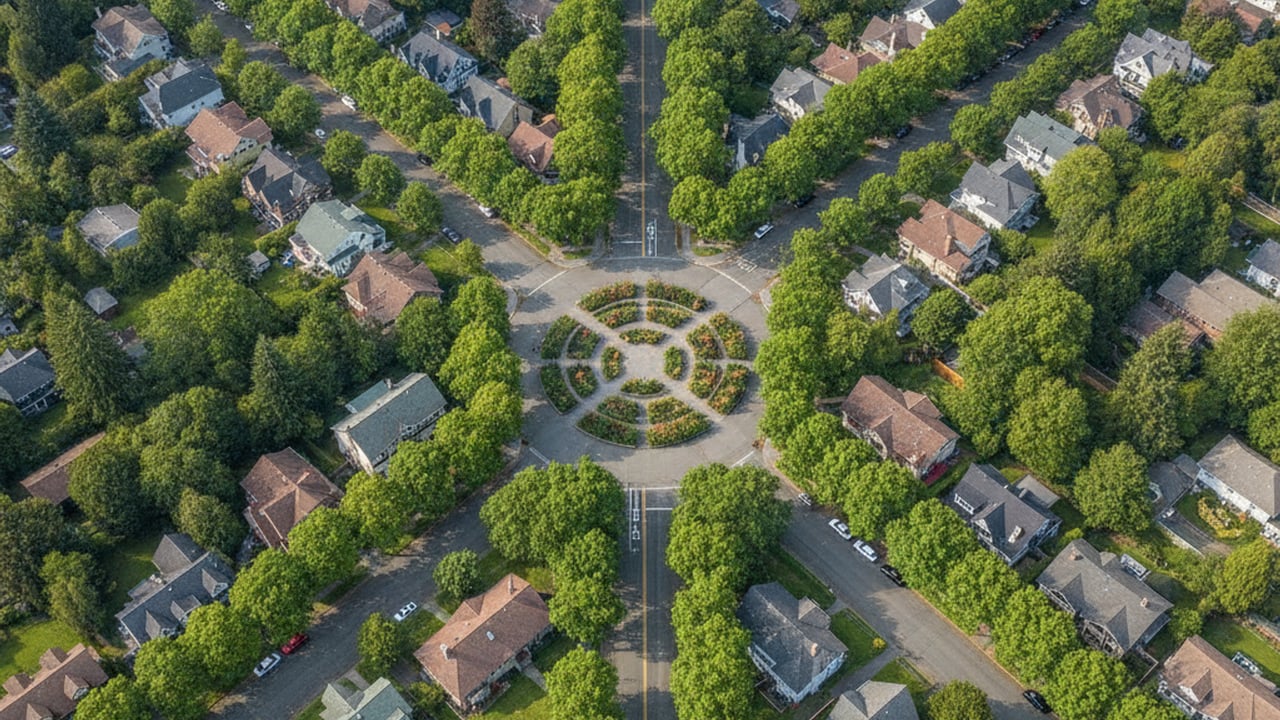
Pull up any map of Portland, OR and Ladd's Addition jumps out immediately as one of the best neighborhoods in Portland - it's where the streets refuse to behave. While the rest of Southeast Portland runs on a predictable grid, this district radiates outward from a central traffic circle, creating diagonal intersections that slow traffic and set the whole area apart architecturally.
Laid out in 1909, the neighborhood has held onto most of its original early-20th-century housing stock and its mature tree canopy. Buyers looking here will find a residential enclave that sits close to commercial corridors like Hawthorne Boulevard - close enough to walk to, far enough that commercial traffic stays off the interior streets.
The Layout and Location of Ladd's Addition
The anchor of the whole design is Ladd Circle Park & Rose Gardens, a 1.62-acre park sitting at the exact center of the street grid. Portland Parks Superintendent Emanuel Mische designed it, and the central circle is planted with camellias, rhododendrons, and azaleas. If you're ever disoriented inside the diagonal streets, this is your reference point.
Radiating out from that center are four diamond-shaped rose gardens - Maple, Orange, Mulberry, and Cypress - containing over 3,000 roses of 60 varieties. They were deliberately arranged to create a stained-glass effect when viewed from above, and the city maintains them. During summer blooming season they pull foot traffic from across Southeast Portland.
Defining the Neighborhood Boundaries
The district runs from SE Hawthorne Boulevard on the north to SE Division Street on the south, SE 12th Avenue on the west to SE 20th Avenue on the east. That's a compact pocket. The diagonal intersections inside it force drivers to slow down in a way that a standard grid simply doesn't, which is a big part of why the interior feels self-contained even though you're squarely in the middle of Southeast Portland.
Step out of the diagonal grid and you're immediately on the straight commercial avenues. That contrast - quiet streets inside, active corridors right at the edges - defines the daily rhythm of living here.
Connecting to the Rest of Portland
Downtown Portland is accessible across the Hawthorne or Morrison bridges, and the flat terrain makes year-round cycling genuinely practical. Cyclists connect from the neighborhood's low-speed interior streets to major bike routes heading into the city center.
For transit, multiple TriMet bus lines run along the border streets of Hawthorne and Division, with direct connections to the MAX Light Rail system and the broader metropolitan area.
Real Estate and Home Prices in the Area
The broader Portland market currently sits at a median sale price of around $561,525, with homes spending roughly 10 days on the market. Ladd's Addition operates in a different tier entirely. Buyers who come in with a typical Southeast Portland budget will need to recalibrate.
Recent estimates put the median home price in Ladd's Addition between $900,000 and $1,150,000. Data from early 2026 places the median sale price slightly above $1.13 million - a substantial premium over the citywide figure. The neighborhood's limited size and the high retention rate among current owners keep supply tight and prices elevated.
Common Home Styles and Architecture
The inventory is almost entirely early-to-mid-20th-century single-family homes. Craftsman bungalows, Tudor Revivals, and classic Foursquare properties built between 1910 and 1930 make up the overwhelming majority of what you'll see. Large front porches, deep eaves, original woodwork - it's all here, and a lot of it is intact.
New construction is rare. The neighborhood's established footprint and historic district designations mean that homeowners who want to remodel or expand have to follow specific design guidelines and submit exterior changes for city review. If you're someone who wants to put a glass addition on the back of a 1918 Craftsman, expect that conversation to be complicated.
Market Pace and Availability
The geographic footprint is small, and the total number of properties reflects that. When a house does list, it tends to attract multiple offers quickly if it's priced in line with recent comparables.
In a city where the median time on market is already just 10 days, well-maintained historic homes here often move just as fast. Come prepared, or you'll miss them.
Dining, Transit, and Daily Life
The neighborhood itself is almost entirely residential. The one exception is Palio Espresso and Dessert House, a café near Ladd Circle Park - that's the extent of commercial life inside the diagonal grid. Everything else sits on the edges: Hawthorne, Division, and 12th Avenue handle the groceries, restaurants, hardware, and pharmacy runs.
For most residents, that arrangement is actually ideal. Quiet evenings at home, with Portland's dining scene a few blocks away on foot.
Local Restaurants and Cafes
The neighborhood's border streets have some well-known options. OK Omens, Grassa, and the Lebanese spot Kabob are among the popular restaurants in and near Ladd's Addition. For breakfast and casual meals, residents walk to Nuestra Cocina, Double Dragon, Lardo, Jam on Hawthorne, and Pine State Biscuits - a solid range without needing a car.
Shopping and Everyday Services
For weekly groceries, most residents use the nearby New Seasons Market or Safeway on Hawthorne Boulevard. Independent boutiques, hardware stores, and pharmacies operate along the same boundary streets.
The practical result is that most daily errands are walkable or bikeable, with designated bike lanes on the main avenues making it easy to cover ground without pulling out the car.
Schools, Healthcare, and Portland Weather
For buyers doing their due diligence, Ladd's Addition falls under Portland Public Schools and sits within a few miles of several major medical centers. The Pacific Northwest climate is also worth understanding up front - the mature elm trees lining the diagonal streets are beautiful, but they add a line item to your annual maintenance budget.
Portland Public Schools Serving the Area
Ladd's Addition is served by Portland Public Schools (PPS). The assignment path runs through Abernethy Elementary, Hosford International Middle School, and Cleveland High School. Abernethy Elementary sits directly in the neighborhood at SE 14th Avenue and Orange Street, which means many kids here walk to school.
That said, school boundaries shift. Verify current enrollment lines directly with the district before you make an offer - don't rely on what was true two years ago.
Nearby Hospitals and Medical Centers
The nearest major facility is Providence Portland Medical Center, about 3.2 miles away and roughly nine minutes by car. There are three hospitals total within a 3.4-mile radius of the neighborhood.
Other major Portland-area hospitals accessible from the district include OHSU Hospital-Marquam Hill Campus, Legacy Good Samaritan Medical Center, Legacy Emanuel Medical Center, and Adventist Health Portland. The established transit routes make those campuses reachable without a car.
What to Expect from the Climate
Portland weather here follows the standard pattern: dry, warm summers and cool, wet winters. For owners of 1920s homes, the wet winters are the maintenance driver - foundations need attention and drainage around the lot matters. Gutters and downspouts have to be cleared regularly to keep water away from basements.
Summer is more forgiving. The tree canopy provides real shade, keeping the streets and older homes cooler than you'd expect. The city's parks department actively manages the historic elm trees to protect them from winter ice storms and high winds, but individual property owners carry their own maintenance responsibilities.
Buying a Home in Southeast Portland
With median prices above $1.1 million and limited inventory, you need financing fully arranged before you start touring. This isn't a neighborhood where you can afford to spend two weeks getting your pre-approval in order after finding a house you want. You may also need to wait several months for a property that fits your specific criteria to come to market at all.
An agent who understands historic properties will save you time and headaches. Evaluating older foundations, updated electrical systems, and local zoning rules on century-old houses is a different skill set than selling a 2005 build in Beaverton.
Touring Homes for Sale
When you're walking through homes here, pay attention to the original features - hardwood floors, built-ins, wood windows. Many properties have been well-updated, but some haven't, and a thorough inspection is required on century-old plumbing and wiring.
Budget for historic home maintenance costs before you fall in love with a place. Replacing a roof or upgrading systems on a house built in 1915 consistently runs higher than the same work on a newer build. That's not a reason to walk away - it's just a number you need to have in your head going in.
Working with a Local Agent
A Portland agent who knows the Southeast quadrant can put Ladd's Addition in context against adjacent neighborhoods like Clinton or Richmond, and give you recent sales data to build a competitive offer around. In a market where homes sell in roughly 10 days, knowing how to structure an offer quickly is a real advantage.
Given how limited the inventory is, your agent should also be tracking off-market opportunities and upcoming listings. When a well-maintained property appears, moving fast is the strategy.
Frequently Asked Questions
What are the historic district restrictions for remodeling or expanding a home in Ladd's Addition?
Strict design guidelines apply because the area is a designated historic district. Homeowners must adhere to specific rules to maintain the neighborhood's early-20th-century architectural consistency. Buyers should consult the city's historic resources program before planning any exterior expansions.
How much of a price premium do homes in Ladd's Addition carry compared to adjacent Southeast Portland neighborhoods?
It's a substantial premium over the broader city market. The Portland median sale price is around $561,525, while recent estimates place the median in Ladd's Addition between $900,000 and $1,150,000. That higher tier reflects the area's historic status and limited housing supply.
Does the unique diagonal street layout in Ladd's Addition make it difficult to drive through or find street parking?
It can disorient first-time visitors since the diagonal streets break from the standard Portland grid. Residents adapt to the pattern radiating from Ladd Circle Park fairly quickly. Street parking availability varies by block, but the low-speed streets generally accommodate resident vehicles.
What should Portland buyers know about the cost of maintaining the mature elm trees and 1920s foundations common in this area?
Budget for higher maintenance costs - that's the short answer. The wet winters require ongoing attention to 1920s foundations and property drainage. The mature elm trees also need regular professional care to prevent damage during winter storms.
How quickly do houses typically sell in Ladd's Addition given the neighborhood's generally low housing inventory?
Very quickly when priced accurately. The broader Portland market already sees a median of just 10 days on the market. Because Ladd's Addition has a small geographic footprint and limited inventory, well-maintained homes here often move at a similar or faster pace.
How does buying a home in Ladd's Addition compare to other historic Portland neighborhoods like Laurelhurst or Irvington?
All three feature early-20th-century architecture and historic district protections. Ladd's Addition stands out specifically for its unique diagonal street grid and central rose gardens. Buyers will find similar price premiums and low-inventory market conditions across all of Portland's established historic neighborhoods like Laurelhurst or Irvington.