The Portland real estate market moves quickly - homes across the city are selling in an average of just 10 days. Citywide, the median sale price sits around $561,000, but buyers looking near the urban core tend to encounter a different set of numbers. Among the best neighborhoods in Portland, two names that come up constantly for buyers chasing historic architecture and walkable streets are Nob Hill and the Northwest District.
A lot of buyers use those names interchangeably, assuming they're talking about the same place. They're not - not exactly. One is a large, officially recognized area; the other is a specific pocket inside it. The distinction matters more than most buyers realize, because the housing styles and price points can be dramatically different depending on which blocks you're actually targeting. Getting that straight early saves you from chasing the wrong listings.
Understanding the Boundaries in Portland, OR
The Northwest District is a large, officially recognized area covering 1.33 square miles on the city's west side. It stretches from the base of the Tualatin Mountains in the West Hills east to Interstate 405, with NW Nicolai Street forming the northern boundary and West Burnside marking the southern edge.
Inside that footprint you'll find several distinct sub-areas: Uptown, Slabtown, the Alphabet District, and Nob Hill. Nob Hill itself isn't a separate city-recognized neighborhood - it's a specific pocket within the Northwest District, generally bounded by NW 17th Avenue to the east, NW 24th Avenue to the west, West Burnside to the south, and NW Lovejoy Street to the north. Some local definitions stretch it a bit further north to NW Thurman Street, centered on the commercial corridors of NW 21st and NW 23rd Avenues. The practical takeaway: any home listed in Nob Hill is technically a Northwest District property.
Historical Context and Layout
The street grid here follows a distinct pattern that dates back to the area's earliest development. The Alphabet District - which overlaps with Nob Hill - earned its name because the east-west streets run in alphabetical order, from Burnside Street up to Vaughn Street. Once you know that, getting around becomes intuitive quickly.
That historical footprint also shapes the density. Properties sit tightly together, tucked alongside older apartment buildings and, in more recent years, modern condominiums that have worked their way into the mix.
Real Estate Markets and Housing Costs
Pricing here varies drastically depending on what you're shopping for. Across the broader Northwest District, recent data shows median sale prices ranging from roughly $460,000 to $575,000, driven largely by the volume of condominiums and townhomes changing hands.
Zoom in on the Nob Hill pocket specifically, and median listing values for condos and smaller units hover around $497,000 to $500,000. But the large historic single-family homes are a different conversation entirely - some analytics sources report the median price for those standalone historic properties at over $1.38 million. The overall Portland market is sitting at around 2,025 homes and a 2.8-month supply as of mid-2026, and homes across the city are selling slightly above list price on average. Don't assume you have time to think it over on a well-priced unit.
Architectural Styles and Property Types
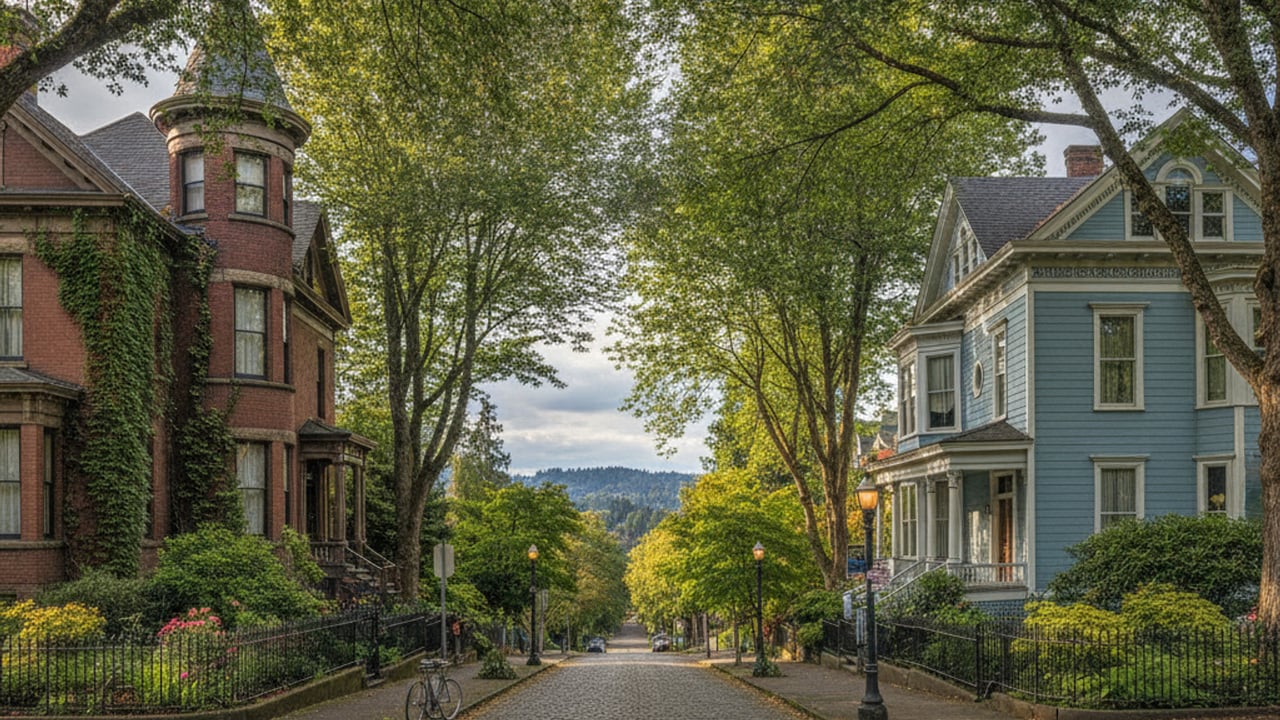
The residential streets of Nob Hill and the Alphabet Historic District are where you'll find some of Portland's oldest and most detailed architecture. Early construction centered on Craftsman and Colonial Revival styles, and you'll also find a dense collection of Victorian-era homes - Queen Anne, Italianate, and Stick-Eastlake designs built around the turn of the 20th century.
Move into the wider Northwest District and the mix broadens. Those historic Old Portland-style and Craftsman houses sit directly next to vintage apartment buildings, and new condominium developments - particularly toward Slabtown - have added modern inventory in recent years.
Daily Life and Local Amenities
The commercial energy of the Northwest District concentrates along NW 21st and NW 23rd Avenues. NW 23rd in particular runs a dense lineup of cafes, restaurants, thrift stores, and high-end retail. For most residents, daily errands and dining out don't require leaving the area at all.
That tight integration of commercial and residential blocks is one of the defining features of living here - you're not driving to a strip mall. You're walking half a block.
Parks and Outdoor Access
Nob Hill's immediate footprint is compact and paved - there are no parks directly within its specific boundaries. That said, residents have quick access to several major green spaces just blocks away in the broader Northwest District.
Wallace Park serves as a central gathering space for the surrounding residential streets. Couch Park and Macleay Park are also within walking distance, with paved paths and open lawns. And for serious hiking, Forest Park sits just to the west - miles of wooded trails accessible right from the neighborhood's edge.
Transit and Commute Times
You don't need a car to get around the Northwest District. The Portland Streetcar's North/South Loop serves Nob Hill directly, connecting the northern end of the neighborhood into Downtown Portland. TriMet Line 15 runs directly down NW 23rd Avenue for bus riders. And for longer trips, Interstate 405 sits just a few blocks east, giving drivers a quick connection to Interstate 5 - north toward Seattle or south into central Oregon.
Walkability and Biking Infrastructure
Portland prioritizes pedestrian and cyclist right-of-way, and the Northwest District reflects that commitment in its infrastructure. Extensive sidewalks and dedicated bike lanes let residents get around without a car, and the flat terrain near the commercial corridors makes biking a genuinely practical option - not just a nice-sounding one - for grocery runs or commuting downtown.
Choosing the Right Fit for Your Search
Where you focus really comes down to the property type you're after. If you want a large, preserved Victorian or Craftsman home with real architectural detail, you're looking at the historic blocks of Nob Hill and the Alphabet District - and you should expect to pay for it. Those properties often exceed $1 million, with some well past that threshold.
If you're working with a lower budget or want modern amenities, widen your lens to the broader Northwest District. Townhomes, mid-century apartments, and new condos - especially toward Slabtown - keep you in the $460,000 to $575,000 range.
Either way, this is a fast market. With citywide days on market hovering around 10 days, have your financing sorted before you start touring properties near NW 23rd Avenue. Showing up pre-approved isn't optional here - it's the baseline.
Frequently Asked Questions
Are Nob Hill and the Northwest District the exact same neighborhood in Portland, OR?
No. The Northwest District is a large, officially recognized area covering 1.33 square miles. Nob Hill is a specific sub-area located entirely within the Northwest District's boundaries - not a separate neighborhood unto itself.
Are home prices generally higher in Nob Hill compared to the broader Northwest District?
It depends on what you're buying. Condos in Nob Hill sit around the $497,000 to $500,000 mark, which lines up with the broader Northwest District median of $460,000 to $575,000. The historic single-family homes specific to Nob Hill are a different story - those often push well past $1.3 million.
Will I find different types of property for sale in Nob Hill versus the wider Northwest area?
Yes. Nob Hill and the overlapping Alphabet District have a dense concentration of historic Victorian, Colonial Revival, and Craftsman homes. The wider Northwest District includes those styles but adds a much larger volume of modern condominiums and older apartment buildings.
Is the rapidly developing Slabtown area considered part of Nob Hill or the Northwest District?
Slabtown is part of the broader Northwest District. It sits adjacent to Nob Hill but is recognized as its own distinct sub-area within the larger district boundaries - not part of Nob Hill itself.