The New Construction Landscape in Portland (2026 Guide)
If you have driven around the metro area lately, you have probably noticed the cranes in the sky and the framing going up in the suburbs. As of February 2026, the market for new homes here is shifting. We are seeing prices stabilize with a modest appreciation forecast of around 2-3% for the year, and inventory is finally starting to loosen up after the tight squeeze of the last few years.
However, buying a brand-new home here isn't quite like buying in Texas or the Midwest. We have a unique constraint called the Urban Growth Boundary (UGB). This state law protects our farms and forests from sprawl, but it also means you won't find massive new subdivisions in the middle of Portland proper. Instead, the large-scale development is pushed to the edges—places like Hillsboro, Wilsonville, and Happy Valley.
Inside the city limits, we are seeing something different: the "missing middle." Thanks to zoning changes, builders are focusing on infill projects—think townhomes, cottage clusters, and four-plexes tucked into established neighborhoods.
Who is buying right now? We are seeing a lot of tech professionals moving into the "Silicon Forest" corridor near Intel and Nike. We also have buyers specifically looking to lower their carbon footprint with energy-efficient builds, and downsizers who want to trade their maintenance-heavy 1920s craftsman for something lock-and-leave. With interest rates hovering in the low 6% range, buyers are getting off the fence, and the competition for the best lots is heating up.
If you are thinking about moving to Portland or just shifting neighborhoods, understanding where these pockets of growth are is step one.
Top Master-Planned Communities to Watch in 2026
Because of the land constraints I mentioned, new inventory tends to come in clusters. There are a few standout master-planned communities that are dominating the conversation this year.
Reed's Crossing (Hillsboro) This is arguably the most significant development in the metro area right now. It is designed as a mixed-use hub, meaning you aren't just buying a house; you are buying into a walkable lifestyle. They have dedicated over 80 acres to parks and open spaces. You will find everything from townhomes to large estates here, usually ranging from $500K to over $800K. It’s a top pick for folks working at the nearby tech campuses.
Frog Pond (Wilsonville) Frog Pond is interesting because it followed an "infrastructure-first" model. The city planned the walkability, the school access, and the high-quality public spaces before the homes went vertical. It feels cohesive rather than chaotic. It is a bit further south, which makes it a strategic spot if you split time between Portland and Salem.
Bethany & North Bethany If you are looking for luxury, this is often the default answer. Builders like Toll Brothers (Hosford Farms) are active here. The area is known for excellent schools and larger executive-style homes. It is very close to the tech corridor, but be prepared for a higher price point and a more suburban, cul-de-sac feel.
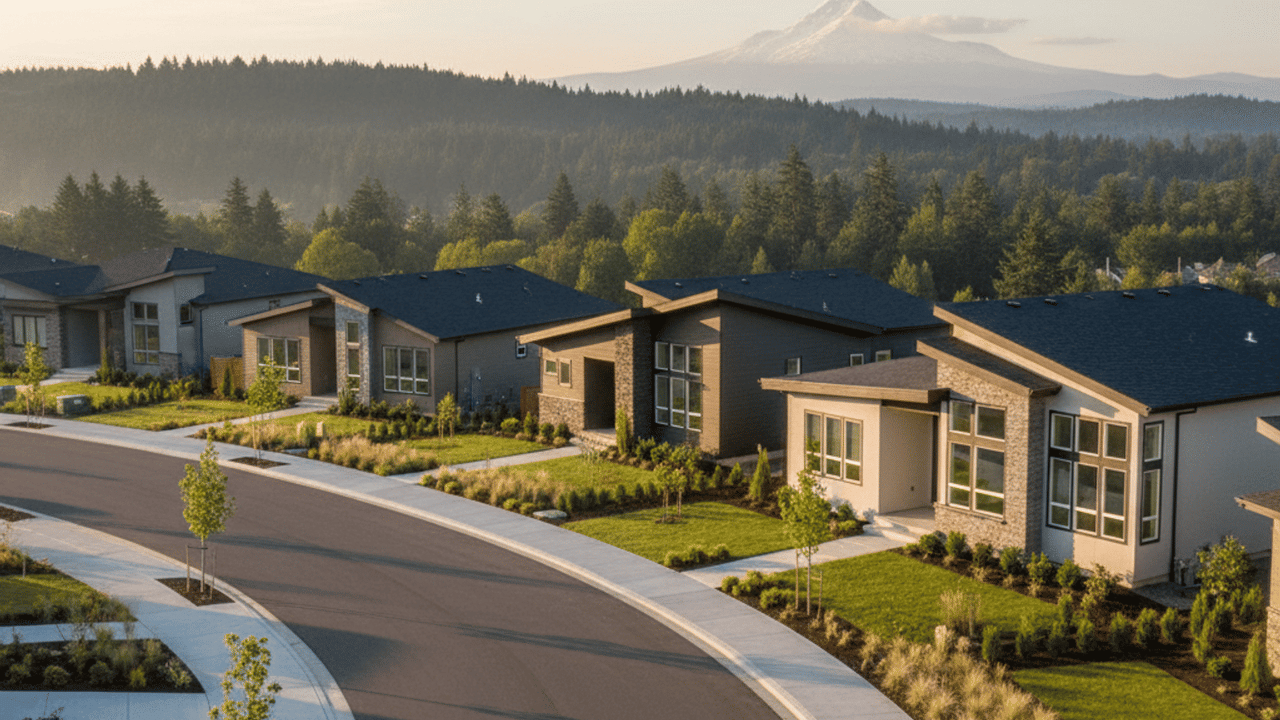
Happy Valley Over on the east side, Happy Valley is exploding with growth. The topography here allows for incredible views of Mount Hood from many new lots. You generally get a bit more land for your money compared to the west side, but you need to factor in the commute; traffic getting in and out of Happy Valley during rush hour can be heavy.
South Waterfront For those who want vertical living rather than a yard, the South Waterfront continues to develop. This is high-rise luxury with a focus on sustainability—many buildings here hit LEED Gold or Platinum standards. Be aware that while the purchase price is one thing, HOA fees here can be steep, often exceeding $600/month to cover the concierge, elevators, and amenities.
Major Builders & Custom Options
When you start touring living in Hillsboro or Wilsonville, you will notice the same names popping up on the "For Sale" signs. It helps to know who you are dealing with.
On the national level, giants like Lennar and D.R. Horton are everywhere. Lennar is famous for their "Everything's Included®" model, which simplifies the buying process because you aren't nickel-and-diming over every faucet choice. Toll Brothers is the other big national player, mostly cornering the luxury market in North Bethany and West Linn.
However, the Pacific Northwest has strong local and regional builders that often offer a different level of craftsmanship. Holt Homes is deeply rooted here and tends to understand the local aesthetic better than some national chains. Pahlisch Homes focuses heavily on community planning, ensuring the neighborhood feels established quickly. Noyes Development is another name to watch if energy efficiency is your top priority; their high-performance specs are often way above code.
We also have specialty builders like Ichijo. They are a Japanese company that builds tech-heavy, highly energy-efficient homes. They are famous for their unique features, like piano-finish cabinetry and cool storage solutions that you just don't see in standard American builds.
Pricing, Styles, and What You Get for Your Money
One of the most common questions is, "How much is this actually going to cost me?" If you look at Portland real estate market trends, new construction generally commands a 15-20% premium over comparable resale homes. Here is how that breaks down by home style.
Townhomes ($450K – $550K) You will see these popping up in Beaverton, Gresham, and on infill lots in Portland. They are typically three stories tall. These are fantastic for getting into the market at a lower price point, and they offer a low-maintenance lifestyle that appeals to busy professionals.
Single-Family Detached ($550K – $850K) This is the "meat and potatoes" of the market—standard 3-4 bedroom homes found primarily in Hillsboro, Tigard, and Happy Valley. At this price point, you are paying for modern open layouts, home offices, and decent finishes, though lot sizes will likely be smaller than what you would find in an older neighborhood.
Luxury & Custom ($900K+) Once you cross the $900K mark, typically in the West Hills, Bethany, or Lake Oswego, the features jump up a level. We are talking about inclusive ADUs (Accessory Dwelling Units) for multi-generational living, smart home ecosystems, and premium natural materials.
The Financials: Taxes, HOAs, and Fees
Buying new in Oregon comes with some specific financial quirks that catch out-of-state buyers off guard.
Property Taxes (The Big Warning) Oregon's property tax system (Measure 50) is complex. When you look at a listing for a new build, the tax history might show a very low number because it was assessed as empty land the previous year. Do not rely on that number. Your taxes will be reassessed based on the value of the new structure. A good rule of thumb is to budget approx 0.8% to 1.2% of the sales price, but always ask us to run the specific millage rate for that neighborhood so you aren't shocked by the bill.
HOA Fees Most master-planned communities have an HOA. The typical range is $250–$350 per month. This usually covers common area maintenance, recreation centers, and sometimes internet. It can go as low as $150 for basic neighborhood upkeep or well over $600 for high-rise condos with staff and gyms.
Warranties One of the financial benefits is the warranty. Most builders offer a 1-2-10 warranty. That usually means 1 year on fit and finish (drywall pops, paint), 2 years on systems (plumbing, electrical), and 10 years on major structural elements.
Pros and Cons of Buying New in Portland
Is buying new right for you? It depends on your priorities.
The Pros The biggest advantage in Oregon is energy efficiency. Our codes are strict, so a 2026 home is significantly cheaper to heat and cool than a 2006 home. You also get modern layouts designed for how we live today—think designated home offices and open kitchens. Another massive "pro" here is seismic safety. Newer homes are bolted to their foundations and built to modern earthquake codes, which provides peace of mind in the Pacific Northwest.
The Cons The trade-off is almost always land. To meet density goals inside the Urban Growth Boundary, lot sizes are shrinking. You might be close to your neighbor. You also have to deal with the "construction zone" lifestyle—mud on the roads and noise at 7 AM—until the phase is complete.
The Commute Factor Location matters. If you buy a new build in Hillsboro or living in Beaverton, you are golden for a commute to Nike or Intel. But if you work downtown and buy in Happy Valley, you need to be realistic about bridge traffic.
Spotlight on Sustainability: Earth Advantage & LEED
I want to circle back to sustainability because it is a major differentiator here. You will often hear builders talk about Earth Advantage certification (Silver, Gold, or Platinum). This is a third-party certification specific to the NW that goes beyond standard code.
Builders will often provide an EPS (Energy Performance Score) for the home, kind of like a miles-per-gallon rating for a car. These homes are typically at least 10% more efficient than standard code, which translates to real monthly savings on utilities and better indoor air quality.
Frequently Asked Questions
Where is the most new construction happening in Portland?
Due to the Urban Growth Boundary, the majority of large-scale new construction is happening in the suburbs like Hillsboro (Reed's Crossing), Happy Valley, and Wilsonville (Frog Pond). Inside Portland proper, new construction is mostly smaller "infill" projects like townhomes or small condo buildings.
Are new construction homes in Portland expensive?
Yes, they typically carry a 15-20% price premium over older resale homes, with average prices for detached homes hovering around $612K. However, buyers often find that the lower monthly utility costs and lack of immediate repair needs help offset the higher upfront mortgage payment.
Do I need a real estate agent to buy a new construction home?
Absolutely. The friendly agent sitting in the model home represents the builder's best interests, not yours. Having your own representation ensures someone is looking out for you regarding contract terms, inspection contingencies, and negotiations, and the builder typically pays your agent's commission.
What is the typical HOA fee for new homes in Portland?
You should budget between $250 and $350 per month for a typical master-planned community with amenities like a pool or clubhouse. Simpler neighborhoods might be closer to $150, while luxury condos in the South Waterfront can easily exceed $600 per month.